
Knees & Skiing #2 — ACL Tear vs. Meniscus Injury: What They Actually Feel Like
Updated: Sep 29
In my last post, I shared how my first serious injury — at 14, on Korea's steepest race slope — turned out to be a complete ACL tear. That raises a natural question: what is an ACL tear, and how is it different from the other injury skiers fear most, a torn meniscus?
Having lived through both, I want to describe what each actually feels like — in the moment, and in motion — in the hope it helps you understand what your own body might be telling you.
A torn ACL: the "pop" and the instability
When my ACL tore, I heard a loud "pop" inside my knee — startlingly loud to me, though no one else could hear it. It felt like a thick rope snapping. That sound is so vivid I'll never forget it. (Doctors often ask a new patient whether they heard a "pop" — it's that characteristic.)
Right after the injury: pain floods in fast, and the knee suddenly feels unusable. The joint feels unstable from side to side.
Walking: the knee feels like it slides or gives way, as if no strength will go into it — every step uncertain.
During sport: in activities that need lateral movement — tennis, skiing, soccer — the knee feels like it might buckle backward, and pain returns again and again.
A torn meniscus: catching, grinding, a "something's stuck" feeling
A meniscus injury feels different. Instead of a clean snap, it's a lingering sensation of tearing or grinding — in daily life, during exercise, or in certain positions — along with a feeling that something is caught inside the knee. It's quieter than an ACL tear, but the discomfort is persistent.
Right after the injury: a strong tearing or scraping sensation, with stiffness when bending and straightening.
Walking: small grinding sounds inside the knee, sometimes a "crunching" that limits how far it will bend.
During sport: pain at specific angles, and a growing sense of instability as the knee fatigues.
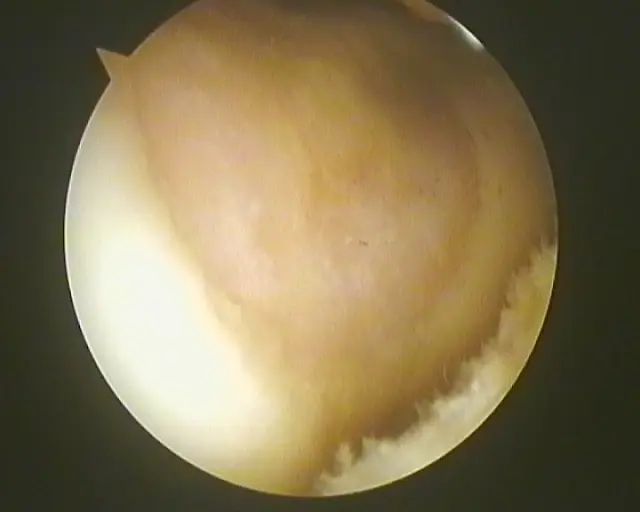
Caption: A tear in my medial meniscus.
arthroscopic image of a medial meniscus tear
The key difference
An ACL tear creates whole-knee instability — a constant feeling the joint won't function. A meniscus injury creates more localized restriction — pain at certain angles and a persistent "foreign-body" discomfort. Both are painful, but distinct: the ACL robs you of stability; the meniscus traps you with catching and limitation.
The images in this post are from inside my own right knee, taken during surgery in 2016. They show two of the injuries I've lived with — a meniscus tear, and the cartilage wear of osteoarthritis that years of skiing and repeated injury can leave behind.

Caption: Cartilage damage (osteoarthritis) inside my right knee.
arthroscopic image of knee osteoarthritis
There's another catch with the meniscus: it doesn't always show clearly on an MRI, so diagnosis can be delayed. And once cartilage is damaged, it barely regenerates. If you feel pain when bending or twisting the knee at certain angles, see a specialist — rest alone may not resolve it.
More than physical pain
For an athlete, a knee injury can feel tied to your very future in the sport. When I first tore my ACL, my mind went blank — I even thought, is this the end for me? What mattered was refusing to give up: recognizing the injury early, getting an accurate diagnosis, and following a rehab plan suited to me. Recovery isn't a short fight; it's a lifelong practice of caring for your body.
Next up
Knowing what an injury feels like is one thing — treating it is another. In the next post, I'll go back to my very first knee surgery in the early 1990s, and what it revealed about sports medicine in Korea at the time.
← Previous: "Knees & Skiing #1 — 1988: My First Knee Injury"Next → "Knees & Skiing #3 — My First Surgery"
Thank you for reading.
A note: this is my personal experience, not medical advice. Every knee and every injury is different — please see your own doctor or specialist for diagnosis and treatment.
These arthroscopic images are from my own knee surgery (2016), courtesy of Dr. Seung-Pyo Eun, Korea Orthopedic Clinic. Shared with permission.
Previous: Knees & Skiing #1 — 1988: My First Knee Injury


Comments